



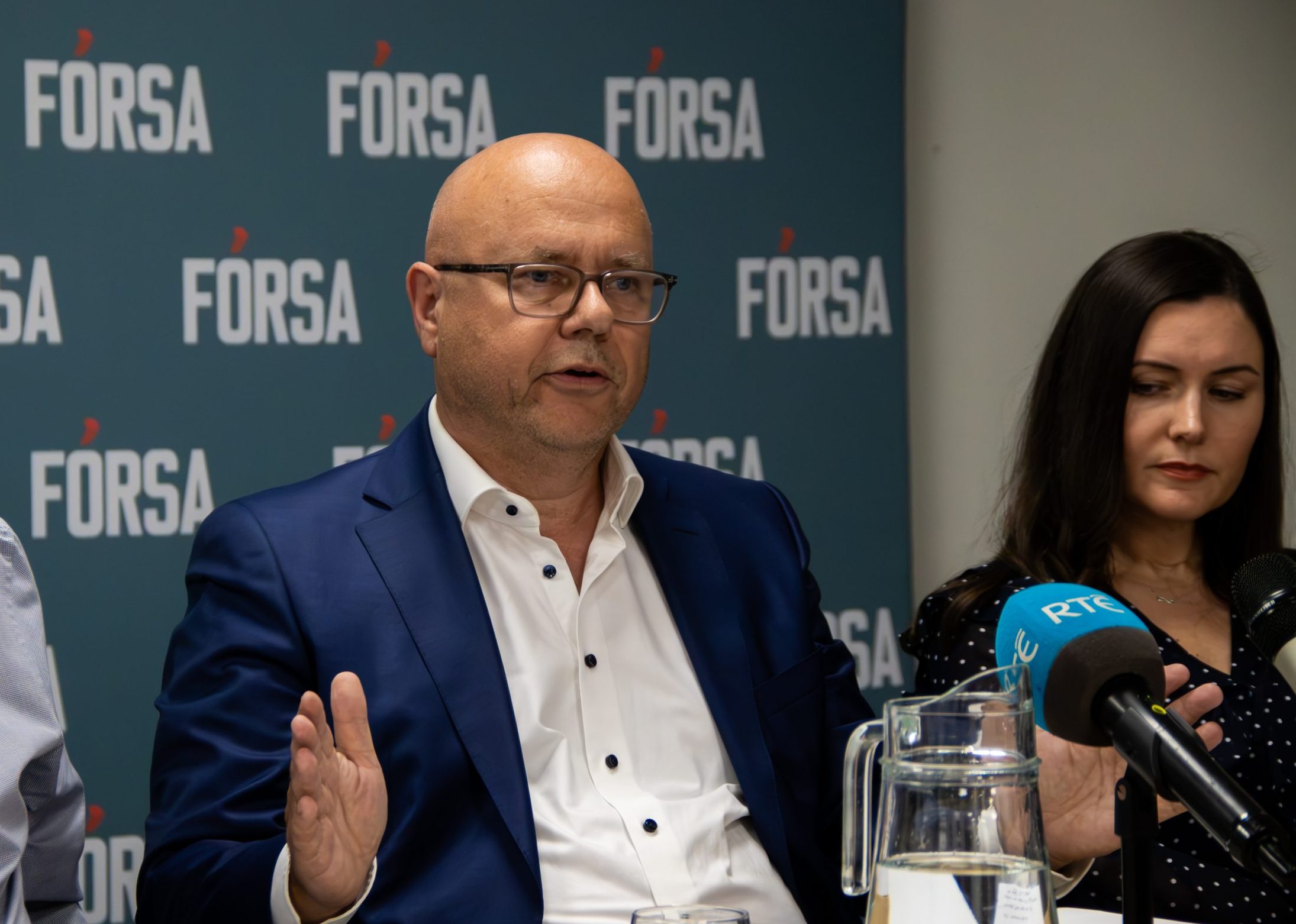
Fórsa staff, members and an assembled press pack gathered in Nerney’s Court last Tuesday with bated breath for one of the biggest moments in Fórsa’s history. James Redmond has this account of what went down.
What might have looked like an ordinary press conference at first glance was far from it. Instead, it represented the culmination of nearly two years of work: thousands of peer-to-peer conversations, and a strategic effort to build the union’s strength.
Flanked by senior union officials, Fórsa general secretary Kevin Callinan quickly got down to business. For him it wasn’t just another run-of-the-mill ballot result.
A historic result
Opening the press conference Kevin emphasised the scale of the ballot, saying: “What I’m about to announce, I believe, is the largest-ever strike ballot by a trade union in Ireland.”
“The number of eligible members, or voting codes issued, was 88,811. The turnout was 64,481, equivalent to 72.6%. Those voting in favour of the proposal for action, up to and including full-scale strike action, numbered 62,276, or 96.6%. Against the proposal were 2,205, equivalent to 3.4%.”
There was an immediate burst of applause from the staff and members – herculean efforts across the summer months had produced something special. Industrial action needs a simple majority of those voting to proceed. The majority in favour of action was a resounding 60,071 of the 90k eligible voters.
“We’re not making this up. This is what people are feeling.”
The strength of the ballot result provides its own answer to claims that unions are exaggerating the pressure workers are experiencing. For Kevin, the message unions brought into exploratory discussions came directly from members themselves via extensive surveys and listening exercises.
“People have been suffering as a result of the cost-of-living crisis. We’re getting that very loud and clear. You can see that in the ballot outcome, and not just for Fórsa. We’re not making this up. This is what people are feeling.”
Deliberate confusion
Throughout the press conference, Kevin batted away clichéd framings of hard-headed union leaders engaged in a performative grandstanding. In fact, Fórsa and other public service unions met Government officials in June to explore the possibility of negotiating a successor to the current public service agreement.
For its part, Government appeared content to fall back on the tired routine of previous multi-annual agreements, seemingly oblivious to how dramatically the ground had shifted beneath them.
Kevin said: “There’s been a lot of confusion – I think a lot of deliberate confusion – in relation to that. For those kinds of agreements to work, they have to protect the living standards of the people they cover.”
Deaf ears
Kevin and other union leaders have been making the case that any new agreement would have to protect workers against rising prices and repair the loss in living standards experienced over recent years. The point, however, appeared to fall on deaf ears.
“We pointed out in the discussions that, over the last five or six years, the pay of the average public servant has fallen significantly behind prices. It was essential on this occasion, if there was to be an agreement, that we had an understanding that this would be addressed.”
That pressure on living standards continued into 2026 with public servants receiving pay increases of 1% in February and another 1% in June. Because of their timing, those increases amount to an average pay increase of around 1.5% across the year, while annual average inflation is running at 3.4%.
“We couldn’t secure a commitment that that would be addressed. Nor could we secure a commitment that there would be a formula or an approach for any subsequent years that would protect living standards, let alone address the gap that has arisen over the last five years.
According to Kevin, the unions did not simply identify the problem, they also put proposals to Government.
“So, it’s untrue to say that we’re unwilling to negotiate. We’re more than willing to negotiate, but we need to have a clear understanding of what the purpose of an agreement on this occasion would be.”
Unions have argued that, if Government want another multi-annual agreement, it should contain a structured mechanism to protect living standards into the future while progressively addressing the gap between public service pay and prices that has already emerged.
The unions estimate that the gap between inflation and the pay of the average public servant over the past five years is at least 5%.
But Government would not give the unions the commitment they were seeking.
“They need to hear clearly what we’re saying. We’re prepared to deal with the issue that we’ve identified over a period of time, but it does require a willingness on their part to recognise that there is a problem that needs to be addressed.
“Otherwise, we’re simply entering into a process where they have basically decided what they’re prepared to spend and we have to suck it up. We’re not going to do that anymore.”
Three months of the same answer
Kevin was clearly aghast at Government’s lack of seriousness about an agreement it knew was running out. It had two and a half years’ notice, yet waited until mid-June to engage. By early July, substantive contact had stopped altogether.
“The Department line has been the same for the last three months, but it’s failing to grasp the issues that we presented to them in June and to make any response to them.”
While the unions have been busy organising and preparing ballots across the summer months – it’s been tumbleweed and radio silence from the Government.
“Unless we get a shift in that, our belief is that we’re probably in for a long haul – a very long dispute, one that will have very serious effects right across the public service.”
More than pay
For Kevin, resolving the cost-of-living question would allow negotiations to move on to the other major challenges facing public services and the people who deliver them. Those include artificial intelligence, remote working, outsourcing and the wider crisis in public service capacity.
But he added that it is difficult to ask workers to confront those challenges collectively while refusing to address the deterioration in their own living standards.
“If we can come at pay in a way where we have a structured approach to how it is going to be dealt with, then we can move on to the other important issues like AI, remote working and outsourcing of services, at a time when we have public services in crisis.”
“But the Government can’t expect us to sit down to try and address those things together if we have a situation where we’re not in a recession and they’re effectively saying to us that we should wait for a recession.”
“If we can’t solve the cost-of-living crisis now, when are we going to do it?”
Working across the public service
Kevin went onto explain how Fórsa will continue to work closely with the other public service unions who are now balloting.
“Our intention is to work closely with all of the other unions. As Chair of the Public Services Committee of Congress, I’m acutely aware of the issues and pressures affecting all public service workers, not just Fórsa members.”
And Fórsa is not alone. Unite, Connect and SIPTU have returned similarly emphatic results, with another 16 unions still in the process of balloting as a wave of mandates for action across the public sector builds.
Join a trade union that wins. Join Fórsa.